
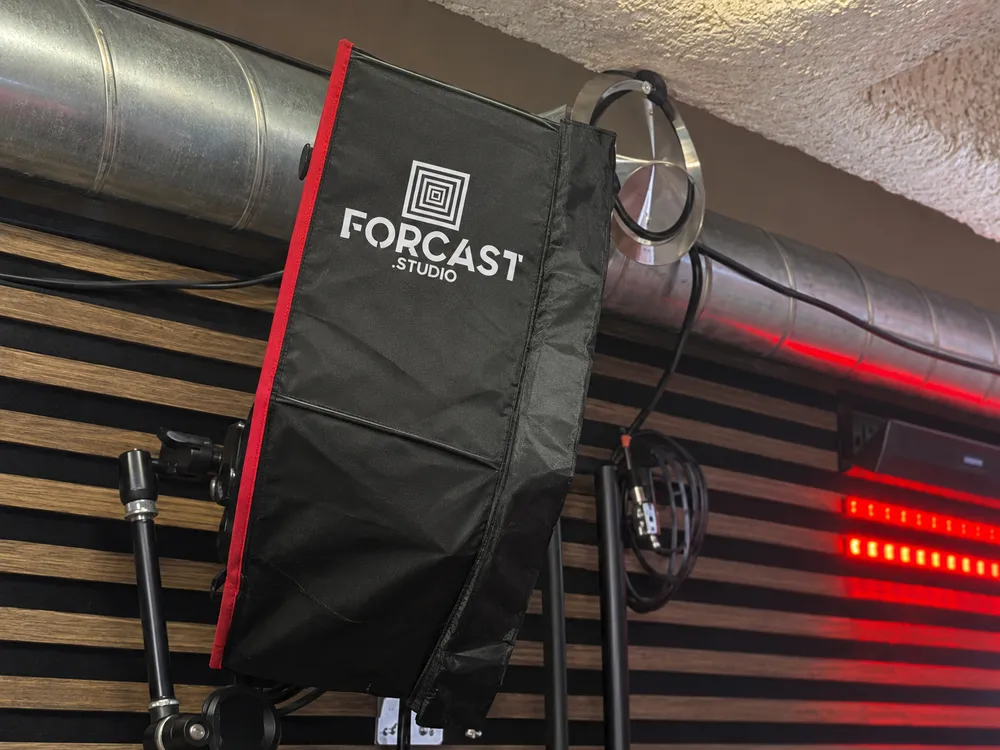
Lighting is what immediately distinguishes an amateur podcast from a professional one. Before judging the sound or content, your audience perceives the image quality, and that depends first on your lighting. The softbox has become the standard for video podcasts: it produces a soft, flattering light that enhances faces and gives a cinematic look. In this guide, you'll discover everything you need to understand, choose, and position your softboxes for a professional video podcast.
1.What is a softbox?
A softbox is a modular box made of reflective fabric, mounted on a light source (LED, flash, or continuous bulb). Its front face is covered with a white nylon diffuser that transforms harsh light into soft light. The result: softened shadows, a smooth light-to-shadow transition, and a much more natural skin rendering than a direct spotlight. This is exactly what a video podcast needs: clearly seeing the guests, without harsh shadows under the nose or eyes. The softbox mimics natural light passing through a sheer window, which is why it's also called 'window light'.
2.Why is softbox ideal for a video podcast?
Three main reasons make softbox the #1 choice for video podcasts: light quality, control, and visual enhancement. The light is soft and homogeneous, flattering all faces regardless of morphology or skin color. Control comes from precisely directing the diffusion: with a grid (honeycomb), you direct light exactly where you want, without parasitic spillage on the set. Finally, the softbox visually enhances your podcast by giving it that 'broadcast look' seen in professional TV shows. Conversely, lighting that's too harsh (bare LED spot, cheap ring light) immediately gives an amateur or harsh look.
Flattering light
Softens imperfections without erasing facial features.
No harsh shadows
Light/shadow transitions are gradual, ideal for video.
Broadcast look
The visual rendering is immediately recognizable as professional.
3.How to position your softboxes? (the 3-point rule)
The standard for filming a podcast is 3-point lighting, a technique inherited from cinema. It combines three sources, each playing a specific role:
- Key light: the most powerful softbox, placed at 45° from the guest, slightly higher than their head. This is what sculpts the face.
- Fill light: a softer softbox, placed opposite the key light. It softens shadows created by the key light, without removing them entirely.
- Back light: placed behind the guest, slightly off-center. It outlines contours, separates the guest from the background, and adds depth.
- For a solo podcast, two softboxes are enough (key + fill). For a duo or trio, multiply key lights or use a large central softbox.
4.Which softbox to choose for a podcast?
The market offers softboxes of all sizes and qualities. For a professional video podcast, here are the criteria that matter: size (60x90 cm minimum for a key light, 50x70 cm for fill), color temperature (5600K for neutral natural light, or bicolor 3200-5600K to adapt to the set), power (100W LED minimum for a well-exposed studio), and diffuser quality (a double diffuser gives even softer light). Reference brands in pro studios: Aputure, Godox, Nanlite, Quasar Science. ForCast.studio is equipped with 5 LED softbox panels, set according to the number of people on camera.
5.Mistakes to avoid with a softbox
Five common mistakes ruin the quality of softbox lighting in a podcast:
- Placing the softbox too far away: light loses softness as it moves away. The rule: the softbox should be 1.5-2 meters from the guest maximum.
- Mixing color temperatures: a 5600K softbox and a 3200K backlight create unmanageable color casts in editing.
- Forgetting the backlight: without a back light, your guest seems 'glued' to the background, the image loses depth.
- Underlighting the set: if you only light the faces, the background falls into darkness and the image looks flat.
- Neglecting the eyes: eyes should always catch a reflection of the softbox (the 'catch light'). This is what makes the gaze come alive on camera.
6.Why rent a softbox studio rather than invest?
Buying a professional softbox setup costs between €2,000 and €6,000 for a complete 3-point kit (3 large-format softboxes, weighted stands, diffusers, DMX controllers). Add to that installation time (1 hour minimum) and the know-how to position them. For a podcaster recording 1 to 4 times a month, renting an already-equipped studio is much more cost-effective. Our studio in Paris 12th has 5 LED softbox panels already in place, with a technician who adjusts the light according to your guests (skin tone, glasses, clothing). You save time and money, with no setup to plan.
Comparison: softbox vs other types of podcast lighting
| Criterion | Ring light / LED panel | Pro softbox (ForCast) |
|---|---|---|
| Light quality | Harsh, marked shadows | Soft, professional |
| Reflections in glasses | Annoying circle/rectangle | Soft, natural |
| Skin rendering | Flat, sometimes yellowish | Sculpted, flattering |
| Suited for pro format | No (amateur look) | Yes (broadcast look) |
| Setup to learn | 5 min (basic) | Included with technician |
| Cost for 1 podcast/month | ~€200 (purchase) | ~€0 (included in rental) |
Softbox lighting included at ForCast.studio
- 5 LED softbox panels
- Customizable key light + fill light + backlight configuration
- Video return / multiview to check the result on screen
- On-site technician / stage manager
- Pre-settings adapted for solo, duo, or trio podcast
- Custom adjustment based on your guests
Who is this guide for?
- Podcasters wanting to upgrade to professional video format
- YouTube creators looking to improve their image rendering
- Companies producing interview or expert content
- Trainers and coaches filming their own masterclasses
- Beginners who want to understand lighting before renting a studio
FAQ
How long does softbox setup take during a session?
No time for you: everything is already in place and pre-set. Our technician makes the final adjustments (skin color, possible glasses, guest position) in a few minutes at the start of your session.
Book online, from €89 incl. VAT per hour.