
Podcasts used to be a 100% audio medium. Today, the biggest podcasts in the world are filmed. Is it just a trend or a necessary evolution? Here's why video has become an essential growth driver.
1.Audio podcast vs Video podcast: the big match
Audio offers passive consumption (in the car, while running), which is its strength. Video requires active attention. But video brings what audio lacks: virality and discovery. Audio retains, video recruits.
2.Discovery: Being found on YouTube and social media
This is argument number 1. Audio platforms (Apple Podcasts, Spotify) have more limited search. YouTube also works as a widely used search engine. By filming your podcast, you access the YouTube algorithm which can recommend your content to strangers. Plus, social media (TikTok, Instagram, LinkedIn) are video-based. A 30-second video clip usually travels much further than an audiogram.
Essential Stream €89 · Pro Edit €149 · Live Cut €229 per hour incl. VAT, reduced rates for 2 to 8 hours.
How renting our Paris podcast studio works
3.Audience: Creating a human connection
The voice transmits emotion, but the face transmits personality. Seeing the host's and guests' expressions, smiles and body language creates a much stronger and faster connection with the audience. We get attached to faces.
4.Engagement and retention
On YouTube, a static video podcast (fixed image) has very low retention. A multi-camera filmed podcast, with dynamic shot changes, maintains visual attention and prevents the viewer from skipping.
5.Monetization: More opportunities
Video opens two new revenue streams: YouTube monetization (YouTube Partner Program) and visual product placements (showing the product, wearing the brand). It's a strong argument for sponsors.
6.The different video podcast formats
There are several ways to do it, from the simplest to the most professional:
Static / Audiogram
A fixed image with sound. Simple but underperforming on YouTube.
Direct to Camera (Solo)
You talk to your camera. Ideal for expertise and personal branding.
The Talk-Show (Multicam Studio)
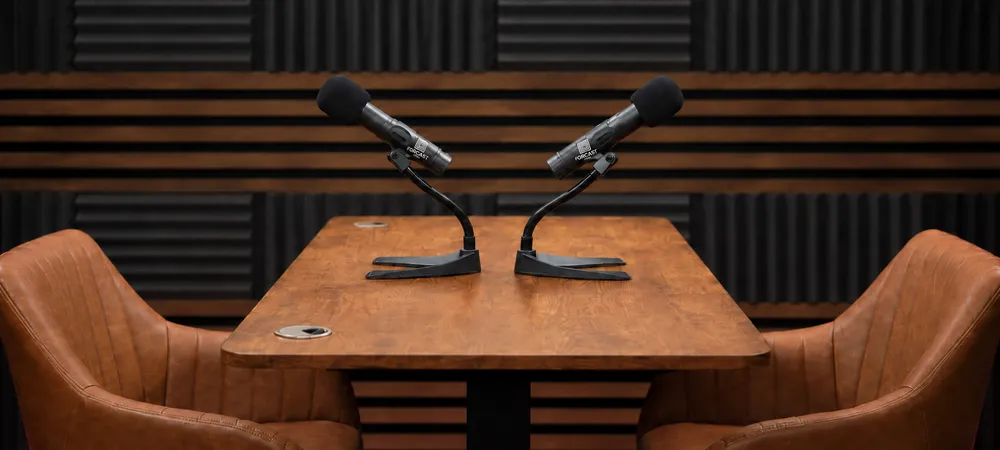
Multiple people around a table, filmed from multiple angles. It's the 'TV' standard of major podcasts (Joe Rogan, Legend, etc.) which offers the best viewing comfort.
Remote Interview (Zoom)
Webcam recording. Lower quality but practical.
7.Costs and complexity
This is the main brake. Filming requires cameras, lighting, and especially video editing (heavier than audio editing). This is where studios come in: they absorb this material and technical cost for you.
8.The ideal workflow
Record in video (studio). Edit the full episode for YouTube. Extract the audio for podcast platforms (Spotify/Apple). Cut 3 to 5 vertical clips (Shorts/Reels) for promotion on social media.
9.The trap to avoid: Neglecting sound
Even in video, sound remains a priority. A 4K video with mediocre sound is unwatchable. Perfect sound with average image is acceptable. Never sacrifice audio for image.
10.ForCast.studio's position
We believe creators shouldn't have to choose. Our studio is designed to offer the best of both worlds: acoustically treated walls and broadcast microphones, coupled with multi-camera 4K video direction. You leave with files ready to be distributed everywhere.
FAQ
Is it much more expensive?
In solo production, yes (equipment purchase). In studio rental, the additional cost is low compared to the added value (visibility on YouTube and social media).
Essential Stream €89 · Pro Edit €149 · Live Cut €229 per hour incl. VAT, reduced rates for 2 to 8 hours.